Jaichung Lee
Ph.D. Candidate in Economics, University of Oregon
My research lies at the intersection of family economics and cultural evolution. I build tractable models of how preferences and norms about family and fertility form, spread, and co-evolve with economic development. My dissertation applies this mechanism to fertility decline in South Korea.
Outside research, I love cooking for people around me, hunting down good food, and traveling.
In Korean, my name is 이재정; the closest pronunciation in English is Jae-jeong.
Fields Development, Family, and Cultural Economics
2026–2027 Job Market Paper
Explaining the Fertility Crunch: The Roles of Intergenerational Income Mobility and Shifting Preferences
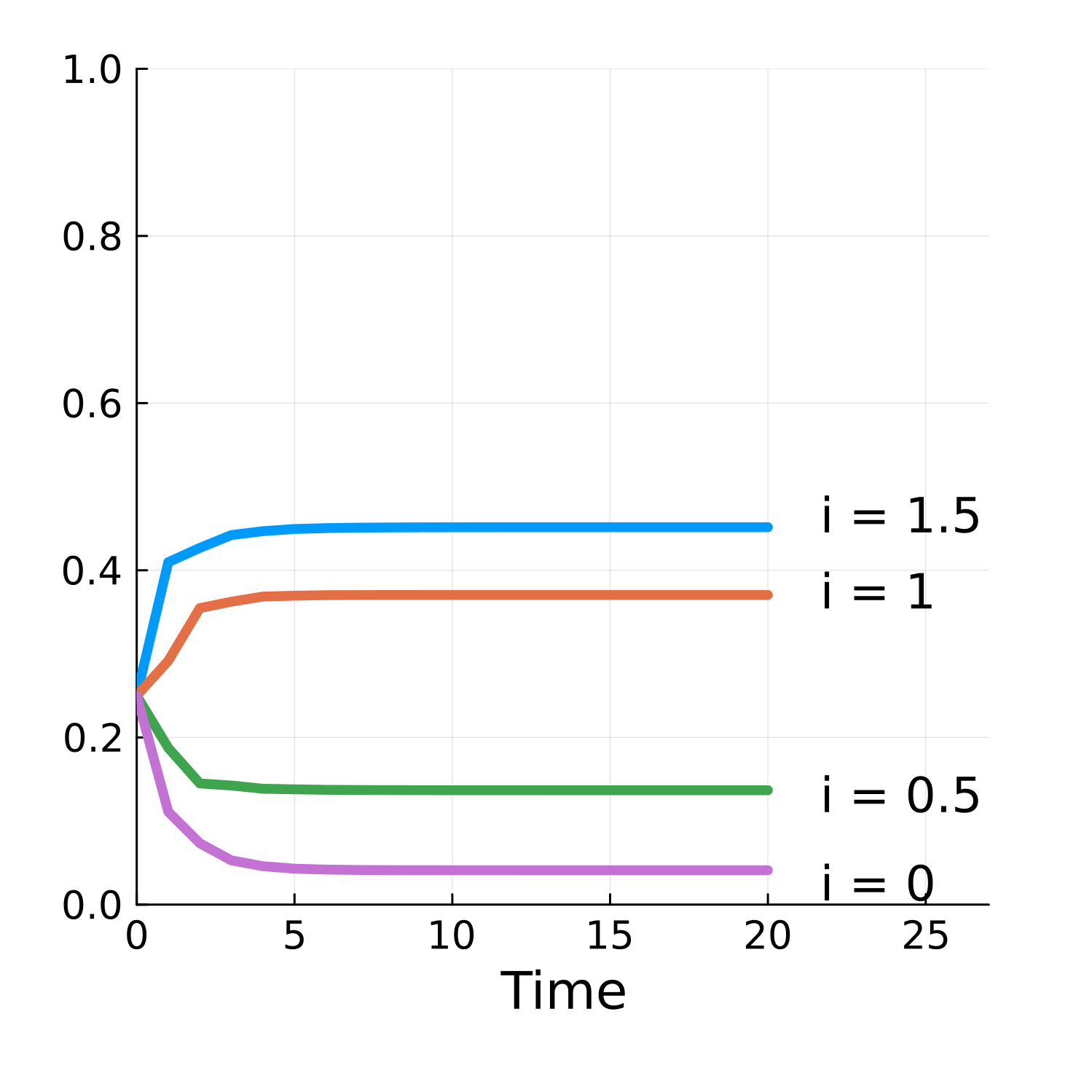
Children inherit fertility ideals from their parents and from society, then revise them by comparing their own economic prospects with their parents'. When upward mobility stalls, this revision offsets the demographic advantage of high-fertility families and holds aggregate fertility at a stable, ultra-low equilibrium.
Abstract
Assuming that preference on fertility is transmitted from earlier generation to the next, the high fertility preference group is expected to eventually dominate creating a homogeneous high preference society as the group is more likely to have more kids leading to faster growth in population than other preference group. However, a significant body of surveys reveals pronounced within-country heterogeneity in fertility ideals and many post-war societies exhibit persistently lowering pattern in fertility. In this paper, I propose a fertility model that children first acquire fertility ideals through cultural transmission, either from parents (vertical) or from the broader adult population (oblique). They then adjust these ideals after comparing their expected income with their parents'. Upward mobility can raise preferences, while downward mobility lowers them. This mobility shock offsets the evolutionary advantage of high-fertility groups, preserving preference diversity and driving the aggregate fertility rate to a stable ultra-low equilibrium. The framework highlights intergenerational mobility as a central, yet overlooked, determinant of fertility dynamics and offers a critical perspective on projections that anticipate a rebound in fertility without accounting for these mechanisms.